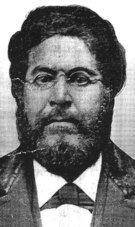
An unusual letter from George Boyer Vashon (1824-1878), a noted African American attorney, educator, and poet, who was a native of Carlisle, Pennsylvania, was recently discovered in the Mary Wager Fisher Papers in the Special Collections Library at Duke University, Wager (as she then was)1 , an American journalist, was particularly active in the movement for education of freedmen. The letter, written in response to a request by Wager for biographical information, provides details of the education and accomplishments of an outstanding individual.
At the time he wrote this letter Vashon was assistant editor of The New Era, published weekly at Washington, which identified itself as ''A National Journal, Edited by Colored Men." Frederick Douglass was a contributing editor.
Washington, D.C., April 9th, 1870
Miss Wager: Circumstances have prevented me from complying with your request of a few days ago, until now that I have leisure to pen down the following notes, which, I trust, may prove acceptable, Very respectfully yours, GEORGE B, VASHON
George B. Vashon was born at Carlisle, Pa. 1824. Blessed with a father who was determined to secure to his only son, at whatever sacrifice, the benefits of education, he commenced his schoolboy days at the age of five years in Pittsburgh, to which place his parents had removed. In 1840, he entered Oberlin College, and graduated as an A.B. four years thereafter. He then studied law under the direction of the Hon. Walter Forward, but as the Committee of the Pittsburgh bar declined to examine him, he concluded to leave his native country for Hayti. While at New York, however, he applied for admission to practice in the Supreme Court of that state, and was, after examination, duly admitted, Jan. 10th, 1848. The two years and a half following he spent at Port-au-Prince, Hayti, the latter portion of that time being Professor of Greek and English in the College Faustin, the principal educational establishment in Hayti. While there, he received from his Alma Mater his diploma as a Master of Arts.
Returning home in 1850, he settled first at Syracuse, N.Y., where he practised law for three years; and then went to McGrawville, having been appointed Professor of Ancient Languages and Belles Lettres at N.Y. Central College in that village. His connection with this institution closing in November, 1857, he returned to Pittsburgh, and took charge of the Colored Public Schools of that city. He resigned this charge in 1863, upon being appointed Principal of Avery College in Allegheny City. In 1867, he came on to Washington, D.C., where he has been engaged, first, as an assistant to the Solicitor's Office of the Freedmen's Bureau, then as a clerk in the Statistical Bureau of the Treasury Department, and lastly, as Assistant Editor of the New Era. During his residence in Washington, he has been admitted to practice as an attorney and counselor both in the Supreme Court of the United States and in that of the District of Columbia.
Although Mr. Vashon has never appeared in book form as an author, he has written considerably both in prose and verse. Vincent Oge, his longest poem, founded upon an incident in Haytian history, was published in a work entitled The Autographs for Freedom, about 1854; and quite a number of his fugitive pieces, including translations from the French and German, have been given to the world through different magazines and newspapers. His prose efforts, published in the same manner, have consisted principally of reviews and essays upon scientific and literary subjects.
While employed as Principal of the Colored Schools in Pittsburgh, Mr. Vashon was married to his assistant teacher, Miss Susan Paul Smith, formerly of Boston, Mass. She, too, is a lady of decided literary tastes, and cordially co-operates with her husband in efforts to train up rightly the five promising children with with their union has been blessed, and their home circle made, indeed, a happy one.2
In 1874, four years after writing this letter, Vashon became a professor at Alcorn University in Rodney, Mississippi, where he died of yellow fever in 1878. He was buried on the campus of the institution.
Read the original article