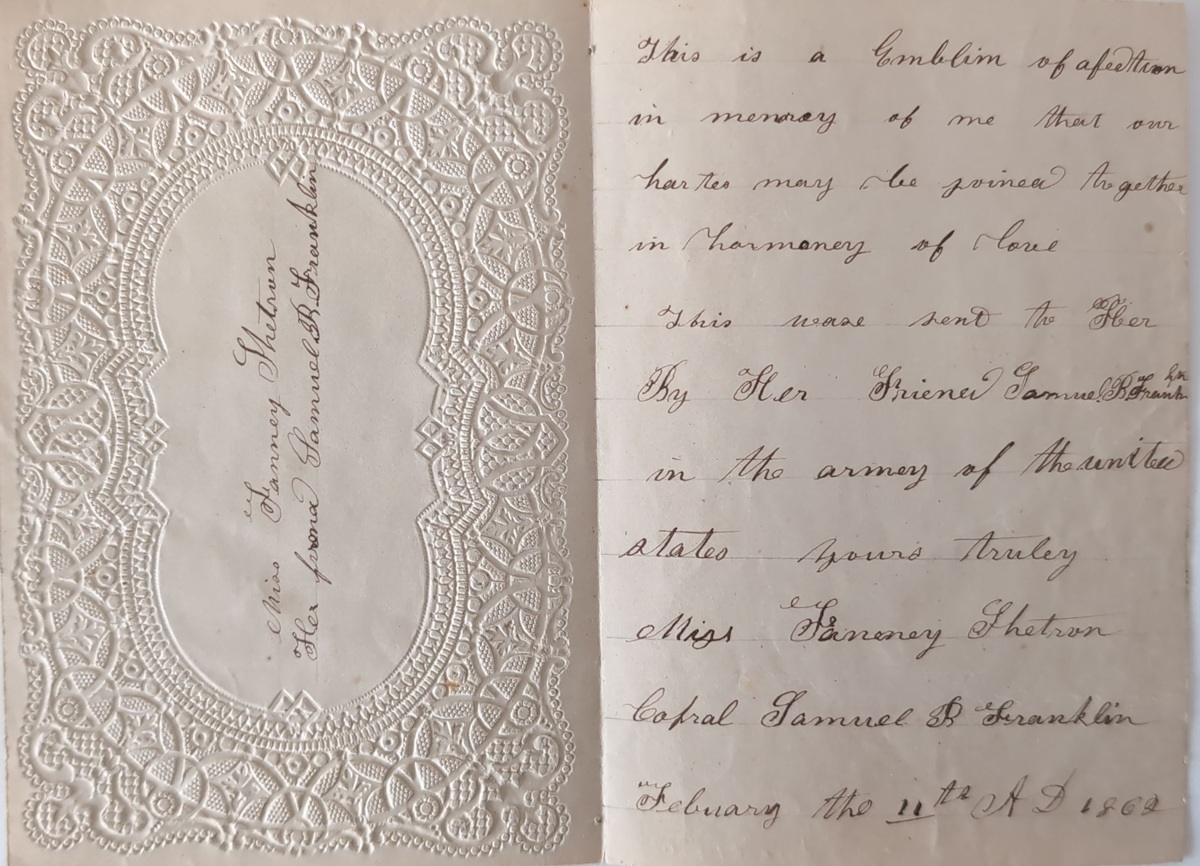
There are many theories about the origins of Valentine’s Day. The Romans celebrated a festival called Lupercalia in honor of the gods of love in mid-February. In 496 the Pope declared that the death of St. Valentine should be celebrated on February 14. In the Middle Ages, February 14 became associated with love, spring, and love birds.
By the mid-1800s Valentine’s Day had gained popularity in America, especially in the 1840s when valentine cards began being mass-produced. Valentine’s Day became a banner day at the post office and for stationers who sold valentine cards. “Valentine mania raged at the highest point,” the newspaper reported in 1848.1 Over 500 cards passed through Carlisle’s Post Office, and men and women waited eagerly for the mail to come. Many would be delighted with poetic cards they received that were embellished with images of cupids and doves, but some would be sad when no cards arrived.
The editor of Harrisburg’s Patriot-News had a sour opinion of Valentine’s Day. “Tuesday next, the 14th will be St. Valentine’s Day—a day which only a few years ago, was one of the greatest importance, especially to young ladies and gentlemen, but which latterly, is allowed to come and go almost unnoticed or celebrated but by a few who still persist in sending to each other…loving, sentimental, and comic [cards.]” He said that ten years ago the post offices were swamped with cards but since the law was passed that letters and cards must be prepaid, the volume has dropped off. “If it were not for the displays in shopkeepers windows,” he said, “Valentine’s Day would hardly be remembered” and he hoped it would die out like “other useless observances.”2
In 1872, Carlisle druggist, Joseph Haverstick, sold thirteen gross of comic valentines as well as many lovely ones. Mr. Piper, the news agent on West High Street sold his entire stock of valentines, “except one.” The post office processed a larger number then they had in the past few years and attributed it to the fact that it was a leap year.3
Both men sold even more cards in 1873. Mr. Piper on West High Street sold 12 gross of comic valentines and almost 400 “fine” valentines. He could have sold five or six hundred more, but he ran out the day before Valentine’s Day. The Post Office reported that 2,000 cards went through its office, and some post office clerks “considered it some sort of punishment for any sins they may have been guilty of during the year.” A typical scene on the pretty cards were “two sentimental lovers hugging each other in a bed of roses, while small cupids with big heads, fire darts at them.” Underneath the image were poems such as “If you love me as I love you, no knife shall cut our love in two.”4 Receiving comic cards on the other hand was not always appreciated. Many cards depicted people with heads like pumpkins, and noses like carrots.
Writing about Valentine’s Day in 1878, the editor of the Valley Sentinel wrote: “If the day has any import at all, let it not be associated with anything which will cause anger or annoyance. The children in their innocence look forward to it gleefully, and it is better to pattern from them and make it indeed a day of charity and affection.”5