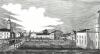
The scene of the murder was the “Sign of the Indian Queen” tavern on Carlisle’s West High Street. The victim was tavernkeeper Robert Grayson. Grayson had been a tavernkeeper in between positions as the county jailer in the 1790s and High Sheriff from 1801-1804. After his term as sheriff, he returned to tavern keeping.
On the night of the murder, February 1, 1810, Sergeant John B. Graves of the 6th Regiment of the U.S. Army previously had a dispute with waggoner John M’Conaughy at John Faust’s Globe tavern on the corner W. High and West Streets. He called on him at the Globe on February 1, but when he discovered that he wasn’t in, Graves went back later that evening with Corporals James Smith, Thomas Manly and Mott, and discovered that the waggoner was lodging at Grayson’s tavern.
It was about 8 o’clock when the men arrived at Grayson’s tavern. Graves went in with one of the men and the others stayed outside the door. Grave’s asked for gin and Grayson said he didn’t have any. He said that he didn’t think he should give the soldiers a drink at that time of night and that they should go back to the Barracks.
Grayson stepped forward to push Sgt. Graves to the door, but Graves pushed Grayson back to the stove and grabbed a stick to defend himself. Graves yelled to the men outside to come in and help. The candles were out, and each of the men picked up a stick or whatever was at hand and a mele ensued. No one knew who attacked Mr. Grayson, but when candles were lit they discovered Grayson lying speechless, and the assailants fled.
The noise of the melee roused some of the townspeople. Henry Barchet had been at the Globe tavern with some cakes to sell to tavernkeeper John Faust when John Sponsler and another tavernkeeper came into Faust’s and asked them if they has heard the noise. Sponsler said “that old Grayson was almost killed by the soldiers and that Grayson’s son George was a vomiting, and that the soldiers give him a damned good kick or tromp.”
John Hagan reported that on the night of the murder he was coming towards Robert Grayson’s and heard a noise. “Hagan said that “he ran down when he heard the cry of “murder,” and when he came to Grayson’s house there was no light in the window.”
Eventually a lighted candle was brought. The neighbors had gathered about the tavern and then they heard a cry that the soldiers had been spotted running from the house. One of the fleeing soldiers fell before he reached the pavement. John Sponsler took hold of the soldier’s arm and “aided and abetted and comported him up the street” until he could run for safety.
Sgt. Graves and Manly were pursued and beaten severely. Manly was taken to jail that night. When Robert Grayson died the next day of a skull fracture, the magistrates sent warrants to the barracks for Graves, Smith, and Mott. Mott escaped, but Graves, Smith, and Manly were jailed for murder. Tavernkeeper John Sponsler was jailed for” assisting in a riot.”
The trial was held on April 6, 1810. It lasted for two days, and the jury brought in a verdict of manslaughter. Judge James Hamilton sentenced Sgt. John B. Graves to four years and five months in solitary confinement in Philadelphia’s prison. Corporal James Smith and Corporal Thomas Manly were sentenced to two years and two months at the same prison.