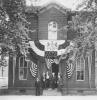
For several days in June 1890 gipsy [sic] women had been annoying many of Carlisle’s citizens by their persistent begging. On Sunday afternoon, June 8, they entered the [yard] adjoining the Thompson house and found Andrew Thompson playing in the yard. “Mrs. Thompson kept an eye on the women and saw that they were endeavoring to gain the confidence of the child by giving him bits of candy. She also heard them ask him if he would like to live with them. The little boy did not take very kindly to the gipsies and they left but returned to town again Tuesday morning and were seen on South Street.”
“The last seen of the little boy by Mrs. Thompson was about 7:30 o’clock and he was playing in the front door [stoop]. Later she discovered that he was nowhere to be seen; she became alarmed [and] started on a fruitless search through the neighborhood. An hour later she rejoiced by having the boy brought home by Robert Chargo...[who] said he found the boy on West Louther Street in the possession of the Gipsy women who had been the day before at the Thompson house. Chargo said the gipsies “were walking rapidly, and each one held a child by the hand and were almost dragging him after them. Chargo was attracted by the child’s cries and stopped the women. He recognized the child as Thompson’s though the gipsies persisted in claiming they belonged to them.” Chargo “however, took the boy from them and restored him to his home. It is probable that an arrest of the women will follow.” 1
Robert Chargo was a well-known Carlisle resident. Born near Winchester, Virginia, he served in the Confederate Army at the opening of the Civil War, but he escaped and joined the Union Army. A preacher living in Lexington, Kentucky at the time, Robert married Nannie Parker of Carlisle on November 3, 1887.2 For several years he worked at Capt. W. E. Miller’s hardware store and later kept a store on North West Street. For a much expanded biography of Robert Chargo, see the Gardner Library article titled Robert Chargo here.