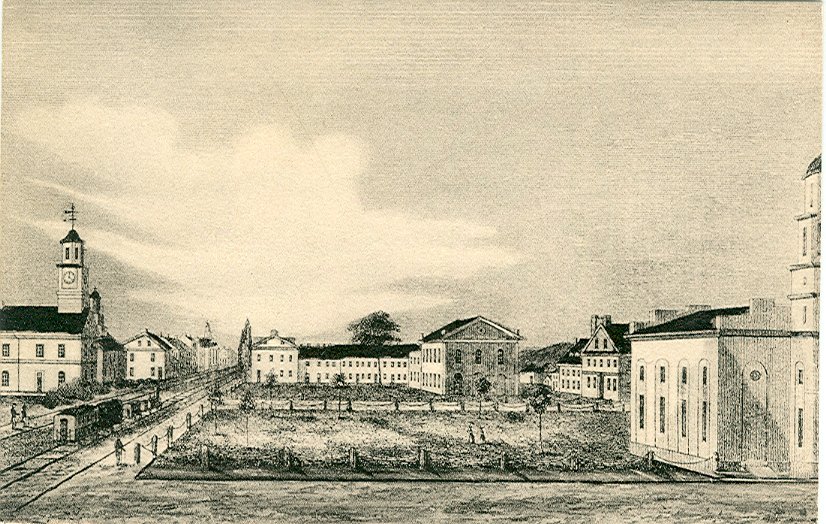
 View of Carlisle's Public Square looking west on High Street. St. John's Episcopal Church is shown in the foreground to the right. The Court House with its cupola is on the left. This engraving is illustrated in Sherman Day's Historical Collections of the State of Pennsylvania, published in 1843.
In 1844, a Mr. Richards of Reading, Berks County Pennsylvania, having heard from some residents of Reading that Carlisle was called the “Athens of Pennsylvania,” decided to visit it and see for himself. When he returned to Reading his impressions of Carlisle were published in the April 17, 1844, edition of the “Reading Journal.” The “Carlisle Weekly Herald” published it for “the curiosity of its readers” in the April 24, 1844, edition of the newspaper. Excerpts follow.
“You will of course suppose that I devoted a due share of attention to the ‘lions’ of the place. The College has much the appearance of a Cotton factory, the buildings being rather of the useful, than ornamental character. The institution is understood to be in a flourishing condition.”
“Carlisle, itself, is a rather pretty place—of course not to compare with Reading, nor indeed Harrisburg; still, it is an agreeable place of residence; In a fertile country; and much praised by its citizens. The college libraries afford excellent means for mental improvement—means which we may hope are not entirely neglected. In fact, some of the ladies are said to be decidedly intelligent.”
“The United States has a company of flying Artillery, or something of the kind here. I did not visit the Barracks, having little taste for the kind of display to be anticipated. I understand the officers, or at least some of them, are quite popular among the ladies.”
He writes, “I was more interested in the courts of justice now in session. The Court house has no great claims—either to external magnificence or internal comfort. It is rather a poorer affair than the old Berks County Court House: the accommodations for the Court, the Bar, and the public are wretched.” He did have a good opinion of Judge Hepburn and said, “he presides with much dignity, and though probably the youngest Judge in the State, has already gained a high reputation as an accomplished jurist.”
Of course he discussed the churches in town. “The churches have no great claims to admiration. I hesitated for some time in front of the Methodist Church, before I could decide if it was a jail or a bank.” St. John’s Episcopal Church came under fire from him. “There is much dissatisfaction in the consequence of the Puseyism of their Rector. Many of the oldest and most intelligent families of the denomination do not enter the church.”
Mr. Richards spent a good portion of his time visiting the Common Schools and found “an excellent system of grading in operation…There are two High Schools, Male and Female, with two grades below…I was indebted to Mr. [James] Hamilton, the Secretary of the Board, for various facilities in acquiring information in regard to the schools, and must congratulate the citizens of Carlisle, upon having secured the services of so efficient a friend of education.”
He summed up his impression of Carlisle thus. “On the whole, Carlisle is a pleasant place, with pleasant people, indigenous and exotic. May their shadows never be less.”