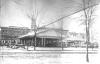
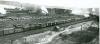
Enola Yard
The Pennsylvania Railroad (PRR) significantly expanded its infrastructure in the early 1900s to handle growing volumes of both freight and passenger traffic.
The Cumberland County Historical Encyclopedia is an expanding publication on the history of the Cumberland County. Covering a wide range of topics and the entire Cumberland County geographic region, the Encyclopedia seeks to be an initial entry point to those interested in the County's history. Entries seek to provide a list of resources available as well as showcasing some of the Cumberland County Historical Society's own collections.
The Pennsylvania Railroad (PRR) significantly expanded its infrastructure in the early 1900s to handle growing volumes of both freight and passenger traffic.
The purpose of this narrative is to document, based on the available evidence, the approximate location of entrenchments said to have been constructed at Carlisle, Pennsylvania, during the French and Indian War.
Mrs. George H. Stewart and her sons Alexander and George, Jr.1 left New York on May 30, 1912 aboard the Carpathia.
When Sarah Filey was growing up in rural Cumberland County in the 1830s and 1840s, she could not have imagined that ten years of her life would be spent more than 5,000 miles away in Constantinople, Turkey.
John and Leo Faller were brothers from Carlisle Pa. who served in the same unit during the war. Their letters to family members provide excellent insight into the thoughts of a typical soldier.
The village of Lisburn is located in the eastern portion of Cumberland County in a loop of the Yellow Breeches Creek and is bounded by York County. An iron forge was established there before the Revolution and a mill in the 1780s.
The Carlisle Borough Charter claims that the First Lutheran Church began about 1765 when the German immigrants of Reformed and Lutheran church background worshiped together in a union church on South Hanover Street near South Street.1 In 1807, the church divided and the Lutherans built
Sometime around 1890, members of Carlisle’s First Lutheran Church decided to create a ladies’ parlor, and one of their members donated a sofa to furnish it.
Regardless of his varied titles of printer, publisher, editor, attorney or federal agent, Tom Flagg was best known about the county as a “character”.
April 1 was known as “flitting day” in Pennsylvania. It was the day when yearly leases expired, and tenant farmers, businessmen, mechanics and private citizens either renewed their leases for another year and “stayed put,” or they moved. Local newspapers usually ran a column or two about the “flittings,” noting the changes in location of hotel keepers and businessmen, and musing on the day in general. The editor of Carlisle’s American Volunteer waxed emotional about “flitting day” in his column on April 5, 1866.