Gas Light Comes to Carlisle
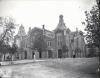
“Introduction of Gas!” proclaimed the Carlisle Herald in its June 4, 1856, edition, while a headline in the June 5, 1856, edition of the American Volunteer reported:
The years from 1850 to 1910 were the height of the carriage era in the United States. Many specialist skills were needed to make these horse drawn vehicles, and carriage makers employed body-makers, blacksmiths to make the ornamental and functional fittings, trimmers to upholster the interiors, body painters and ornamental painters.
In 1866, Abraham B. Sherk and his family moved to Carlisle where he established a carriage making business with his younger brother Noah. They made carriages, buggies, wagons, sulkies, sleighs, and they also repaired and repainted second-hand vehicles. In December 1868 they moved to their newly built carriage factory on the northeast corner of South Pitt and South streets.1 Five months later they dissolved their partnership by mutual consent.2
The 1870 U. S. Census of Carlisle showed that thirty-five-year-old Abraham was doing well. His real estate was valued at five thousand dollars and his personal estate at seven thousand. Abraham’s occupation was listed as “carriage trimmer.” His household included his wife Sarah, aged 34, and three sons, Andrew aged 9, Clinton H. aged 3, and John H. aged 2. Twenty-year-old Anna Gettle was their servant. Three apprentices were living in the household: John Murray, aged 17, a coach worker, 18 year-old John Hardy a trimmer, and 20-year-old James Atkins, a body maker.
In addition to his carriage factory on South Pitt and South streets, in the Fall of 1871, Mr. Sherk purchased the coach shop on North Pitt Street (on the corner of Dickinson Alley) and put Adam Senseman in charge of it. The newspaper reported that “both shops furnish employment for 20 hands.” 3
In March 1872, a reporter from the Carlisle Herald visited the Carlisle Carriage Factory, and he wrote an article about Sherk’s business for the March 14 edition of the newspaper. He reported that Mr. Sherk, who has a yearly public sale of his vehicles, would probably not have a sale this spring because of all the new orders he has.
Taking the reporter on a tour of the factory, Mr. Sherk showed him an elegant two-seated phaeton that was being built for Rev. J. D. Brown, of the Methodist Episcopal Church on South West Street. He had been a Foreign Missionary in India for nine years and intended to take the vehicle back to India with him in the next few months.
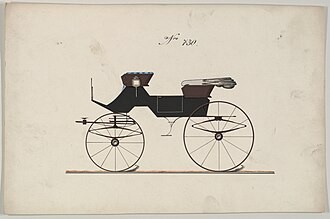
Carriage design for Two Seat Phaeton, no. 730, Brewster & Co.
Wikimedia Commons
Mr. Sherk also showed the reporter a light piano box buggy they had just built for Mr. Charles H. Mullin of the Mt. Holly Paper Company.
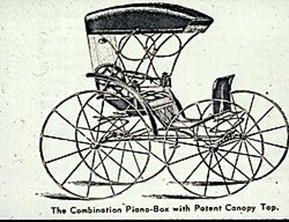
Wikimedia Commons
Sherk’s Factory was currently making three top buggies for Lewis Bosh’s livery in Chambers-burg, and a business wagon for Messrs. Wolf & Hench, Brant’s Hall, Harrisburg.
In the spring of 1876, the Carlisle Herald was doing a series of articles about Carlisle Industries and sent a reporter to Sherk’s Carlisle Carriage Factory to describe the amount of work on hand and the management of the factory. The reporter started his tour of the factory on the third floor where a large number of vehicles were being built. That floor also housed the paint finishing and ornamental room under the charge of Morris W. Hackman. The wood department was on the second floor under the direction of John Whistler. Mr. D.C. Grumbine was the superintendent of the blacksmith shops, and the finishing department was superintended by Harry Elliott of Chambersburg. The ground floor was the equivalent of a car dealership showroom. The reporter counted thirty new vehicles. He was especially attracted to “a handsome express wagon which would be the machine for some of the bakers,” and reported that “a three-seated top phaeton was in readiness to be shipped to V. H. Newcomer, of Funkstown, Maryland.”
“Suffice it to say,” he reported, “that [the vehicles] embrace all the latest styles, including light jagar wagons, light piano box buggies, coal box buggies, jump-seat carriages, etc.” The factory employed ten men who were kept busy working full time.4
In August 1880, Mr. Sherk formed a co-partnership with Morris W. Hackman who had worked for the Carlisle Carriage Works for fifteen years. The new firm was known as Sherk & Hackman.5
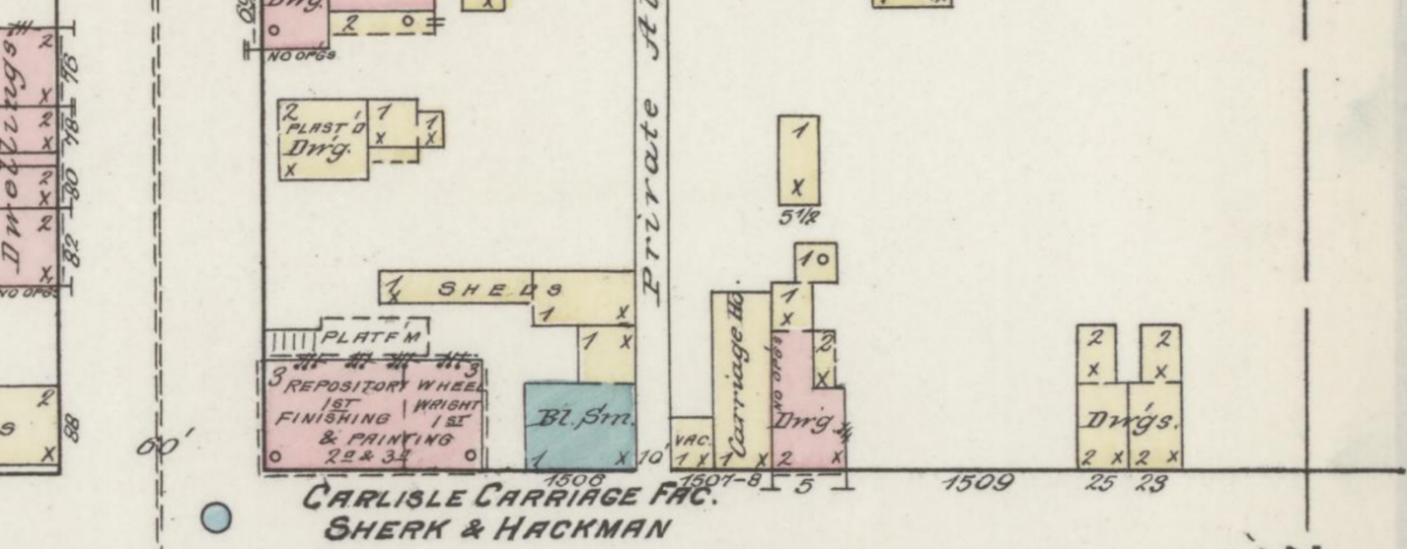
The 1885 Sanborn Fire Insurance Map of Carlisle recorded that the factory complex consisted of a three-story brick factory building, one-story wooden sheds, and a one-story stone blacksmith shop.
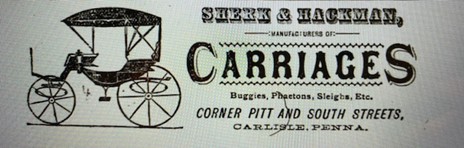
The partnership of Sherk & Hackman came to an end in 1887 when Mr. Hackman retired. When Mr. Sherk retired in 1899, the factory was sold to A. J. Kutz of Newville who made some alterations to the building for his implements business.6 In 1900 Mr. Kutz built his residence next door to the factory with the same kind of bricks used to build the First Lutheran Church in Carlisle. The factory building is still standing as is the Kutz house on South Pitt Street.
“Introduction of Gas!” proclaimed the Carlisle Herald in its June 4, 1856, edition, while a headline in the June 5, 1856, edition of the American Volunteer reported:
1 Carlisle Herald, December 11, 1868.
2 Noah Sherk, and his family moved to Iowa in 1877. His obituary and photograph are in the Cedar Rapids, Iowa Gazette, January 18, 1927, p. 3.
3 Carlisle Herald, March 14, 1872.
4 Carlisle Herald, March 16, 1876, 3.
5 Carlisle Herald, September 2, 1880, 3.
6 Carlisle Evening Herald, September 25, 1899, 1.